
Floors and Structural Connections Overview
Understanding how floors connect with other structural elements is a fundamental requirement in building design and construction. Floors are not isolated components; they work together with columns, beams, and walls to transfer loads safely to the foundation. A clear floors and structural connections overview helps designers, engineers, and BIM professionals ensure structural integrity, constructability, and long-term durability of buildings.
This blog explains how floors interact with structural members, how connection detailing affects performance and visibility, and how slab edges and floor finishing techniques influence both structure and aesthetics.

Importance of Floors in Structural Systems
Floors serve multiple roles in a building. Structurally, they act as horizontal diaphragms that distribute loads. Functionally, they define usable spaces. A well-designed floor system improves stability, controls deflection, and enhances overall building performance.
In a complete floors and structural connections overview, it is essential to understand:
-
Load transfer mechanisms
-
Interaction with vertical and horizontal elements
-
Detailing at joints and edges
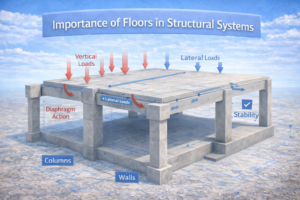
How Floors Interact with Columns, Beams, and Walls
Load Transfer Mechanism in Floor Systems
Floor slabs receive loads from occupants, furniture, equipment, and finishes. These loads are transferred through slabs to beams or directly to columns and walls depending on the structural system.
-
One-way slabs transfer loads primarily in one direction
-
Two-way slabs distribute loads in both directions
-
Flat slabs transfer loads directly to columns
Understanding this load path is critical for accurate design and modeling.

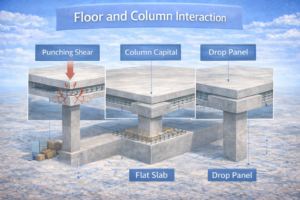
Floor and Column Interaction
Columns are vertical load-bearing elements, and their connection with floors must be carefully detailed to avoid failures such as punching shear.
Punching Shear at Column Connections
Punching shear occurs when concentrated loads from slabs cause localized failure around columns. Designers address this by:
-
Increasing slab thickness
-
Adding drop panels
-
Using shear reinforcement
Column Capital and Drop Panels
Column capitals and drop panels increase the effective depth of slabs, improving load resistance and reducing deflection.
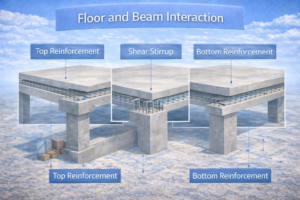
Floor and Beam Interaction
Beams support slabs and transfer loads to columns or walls. The interaction between beams and floors determines slab thickness, reinforcement layout, and deflection behavior.
Supported vs Monolithic Connections
-
Supported slabs rest on beams without rigid bonding
-
Monolithic slabs are cast integrally with beams
Monolithic construction improves stiffness and continuity, while supported systems allow easier construction in some cases.
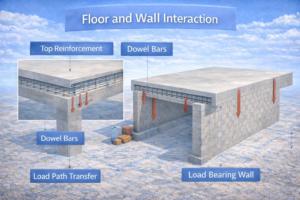
Floor and Wall Interaction
Structural walls often act as both load-bearing and lateral resistance elements. Floors connect to walls to provide diaphragm action.
Load-Bearing Walls
Floors distribute loads evenly to load-bearing walls, reducing stress concentration.
Shear Walls
In seismic zones, floors tie into shear walls to resist lateral forces, ensuring stability during earthquakes.
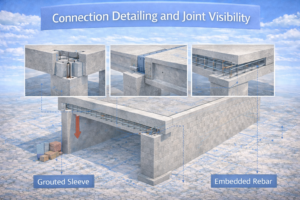
Connection Detailing and Joint Visibility
Connection detailing plays a major role in structural performance, durability, and appearance. Poorly detailed joints can lead to cracks, water ingress, and long-term damage.
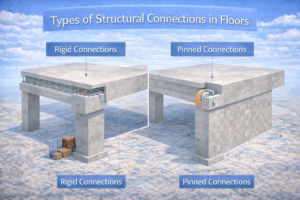
Types of Structural Connections in Floors
Rigid Connections
Rigid connections allow moment transfer and provide continuity. These are commonly used in:
-
Reinforced concrete frames
-
Flat slab systems
Pinned Connections
Pinned connections allow rotation and are often used in steel structures to reduce moment forces.
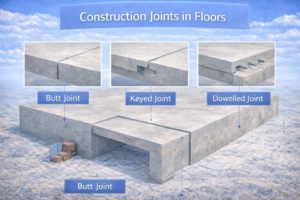
Construction Joints in Floors
Construction joints are planned breaks in concrete pouring. Their location and detailing must ensure continuity and strength.
Expansion Joints
Expansion joints allow movement due to temperature changes and prevent cracking.
Control Joints
Control joints guide crack formation to predetermined locations, improving visual appearance.
Joint Visibility and Architectural Impact
Visible joints can affect aesthetics, especially in exposed concrete floors.
-
Poor joint alignment results in uneven finishes
-
Proper joint spacing enhances symmetry
-
Concealed joints improve visual continuity
Architects and structural engineers must coordinate joint locations early in the design phase.
Slab Edge and Floor Finishing Techniques
Slab edges are often exposed elements that influence both structural performance and architectural expression.
Importance of Slab Edge Detailing
Slab edges affect:
-
Load transfer
-
Crack control
-
Thermal performance
-
Visual appearance
Incorrect slab edge detailing can lead to spalling, corrosion, and uneven finishes.
Common Slab Edge Types
Flush Slab Edge
The slab aligns with the wall face, creating a clean exterior appearance.
Thickened Slab Edge
Used to improve strength at edges and support facade loads.
Cantilevered Slab Edge
Common in balconies and terraces, requiring careful reinforcement to control deflection and cracking.
Thermal and Moisture Considerations
Slab edges are vulnerable to thermal bridging and moisture penetration.
-
Insulation reduces heat loss
-
Waterproof membranes prevent seepage
-
Edge protection improves durability
Ignoring these factors can cause condensation, mold, and structural deterioration.
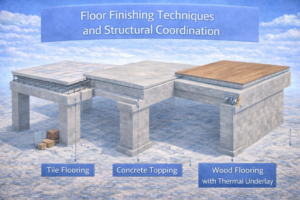
Floor Finishing Techniques and Structural Coordination
Floor finishes add dead load and must be considered in structural design.
Common Floor Finishes
-
Tiles
-
Marble or stone
-
Screed and epoxy coatings
-
Carpet and vinyl
Each finish has different thickness, weight, and bonding requirements.
Screed and Leveling Layers
Screed layers provide level surfaces but add load to slabs. Excessive screed thickness can cause:
-
Increased deflection
-
Cracking
-
Uneven load distribution
Coordination between structural and architectural drawings ensures correct screed allowances.
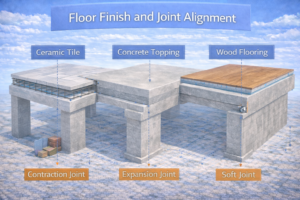
Floor Finish and Joint Alignment
Finishing materials should align with structural joints to avoid visible cracks.
-
Tile joints aligned with control joints
-
Expansion joints covered with flexible profiles
-
Continuous finishes detailed with movement allowances
Coordination Between Structural and BIM Models
In modern construction, BIM plays a critical role in visualizing and coordinating floors and connections.
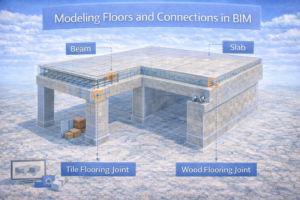
Modeling Floors and Connections in BIM
Accurate BIM modeling helps identify:
-
Clash issues
-
Incorrect slab thickness
-
Misaligned beams and columns
A detailed floors and structural connections overview in BIM improves design accuracy and reduces site errors.
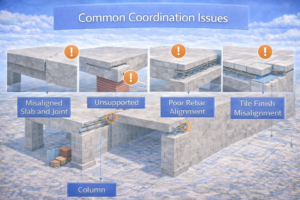
Common Coordination Issues
-
Beams conflicting with floor finishes
-
Columns misaligned with architectural grids
-
Slab openings missing reinforcement
Early coordination meetings and model reviews prevent costly rework.
Best Practices for Floors and Structural Connections
Design Best Practices
-
Follow clear load paths
-
Avoid abrupt changes in slab thickness
-
Detail joints carefully
Construction Best Practices
-
Maintain proper curing
-
Ensure accurate reinforcement placement
-
Protect slab edges during construction
Long-Term Performance
-
Regular inspections
-
Proper waterproofing
-
Timely repair of cracks and joints

Conclusion
A clear floors and structural connections overview is essential for creating safe, durable, and visually appealing buildings. Floors do far more than provide walking surfaces—they connect structural elements, distribute loads, and stabilize entire structures. Understanding how floors interact with columns, beams, and walls, along with proper connection detailing and slab edge treatment, leads to better design decisions and fewer construction issues.
By integrating structural knowledge with architectural intent and BIM coordination, professionals can deliver high-quality buildings that perform well throughout their lifecycle.