What Is BIM? Why Revit Is Important
What Is BIM? Why Revit Is Important is a question many professionals ask as the construction industry continues to evolve rapidly. Today’s buildings are far more complex, requiring project teams to handle architecture, structure, MEP systems, sustainability, and cost control at the same time. Because of this complexity, traditional 2D drawings no longer meet the demands of modern construction projects.
To address these challenges, the industry has adopted Building Information Modeling (BIM). BIM provides a smarter and more coordinated approach to planning, designing, constructing, and managing buildings. This transition clearly highlights what BIM is and why Revit is important, as Revit plays a crucial role in improving accuracy, collaboration, and efficiency within BIM-based workflows.
To fully understand What Is BIM? Why Revit Is Important, it is necessary to first explore the core principles of BIM.
What Is BIM?
Meaning of Building Information Modeling
BIM stands for Building Information Modeling. It is a digital process that creates an intelligent 3D model of a building. Unlike simple drawings, BIM models store both geometry and detailed information.
In BIM, designers create walls as real walls, not just lines. Similarly, doors, windows, and systems behave like actual building components. As a result, the model becomes more accurate and reliable.
BIM Is More Than Just 3D Modeling
Although many people associate BIM with 3D visuals, BIM actually represents a complete workflow. It supports every project stage, including:
-
Planning
-
Design
-
Coordination
-
Construction
-
Operation and maintenance
Because of this, BIM follows the building throughout its entire lifecycle.
How BIM Works
One Central Digital Model
In BIM, teams work on a single central model. Floor plans, sections, elevations, and schedules all come from this model. Therefore, when someone makes a change, every related drawing updates automatically.
As a result, teams avoid inconsistencies and reduce coordination errors.
Information-Rich Building Elements
Each element in a BIM model contains valuable information, such as:
-
Dimensions
-
Materials
-
Cost data
-
Manufacturer details
-
Performance properties
Because of this embedded data, teams can easily generate quantities, estimates, and maintenance schedules.
BIM Dimensions Explained
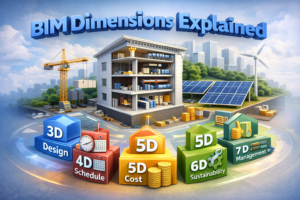
3D BIM – Design and Visualization
First of all, 3D BIM focuses on geometry and visualization. It helps designers present ideas clearly and allows clients to understand the design before construction starts.
4D BIM – Time and Scheduling
Next, 4D BIM connects the model with the construction schedule. As a result, teams can simulate construction sequences and plan work more efficiently.
5D BIM – Cost Management
In addition, 5D BIM links cost information with model quantities. This connection improves accuracy in budgeting and cost control.
6D BIM – Sustainability
Moreover, 6D BIM supports energy analysis, material performance, and sustainability planning.
7D BIM – Facility Management
Finally, 7D BIM helps building owners manage maintenance, assets, and operations after construction ends.
Why BIM Is Important in Construction
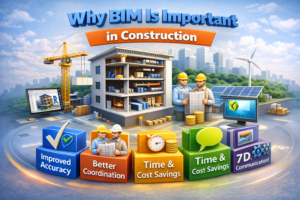
Improved Accuracy
BIM improves accuracy because teams model everything digitally. Consequently, they detect problems early instead of discovering them on site.
Better Coordination
Moreover, BIM allows architectural, structural, and MEP teams to coordinate their work. As a result, clashes reduce significantly.
Time and Cost Savings
Because BIM reduces rework and material waste, projects finish faster and stay within budget.
Clear Communication
Furthermore, 3D BIM models make communication easier. Clients, contractors, and site teams can understand the design without confusion.
Introduction to Revit
What Is Revit?
Revit is a professional BIM software used for building design and documentation. It supports architectural, structural, and MEP workflows in one platform.
Most importantly, Revit uses parametric modeling. Therefore, when users change one element, the entire model updates automatically.
Why Revit Is Important for BIM
Single Source of Information
Revit uses one model as the main source of data. As a result, all drawings and schedules remain consistent.
Automatic Model Updates
Whenever users modify the model:
-
Plans update instantly
-
Sections update automatically
-
Elevations update correctly
-
Schedules update accurately
Because of this automation, teams save a significant amount of time.
Multi-Discipline Collaboration
Additionally, Revit allows architects, structural engineers, and MEP engineers to work together efficiently. Consequently, coordination improves across disciplines.
Revit for Architects
Design Development
Architects use Revit to develop concepts quickly. Moreover, they can test multiple design options without redrawing everything.
Faster Documentation
Revit generates drawings directly from the model. Therefore, architects spend less time drafting manually.
Consistent Design Output
Since all drawings come from one model, design consistency remains intact throughout the project.
Revit for Structural Engineers
Accurate Structural Modeling
Structural engineers model beams, columns, slabs, foundations, and reinforcement accurately in Revit.
Analysis Integration
In addition, engineers can link Revit models with analysis tools. As a result, they avoid repetitive work and reduce errors.
Revit for MEP Engineers
Smart System Design
MEP engineers design HVAC, electrical, plumbing, and fire systems using intelligent components.
Clash Detection Support
Because Revit supports coordinated models, engineers can identify clashes early and resolve them before construction.
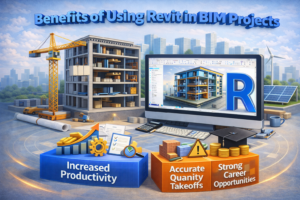
Benefits of Using Revit in BIM Projects
Increased Productivity
Automation reduces repetitive tasks. Consequently, teams deliver projects faster.
Improved Quality Control
Because teams detect errors early, overall project quality improves.
Accurate Quantity Takeoffs
Revit generates quantities directly from the model. Therefore, estimates remain reliable.
Strong Career Opportunities
Since companies worldwide use Revit, professionals with Revit skills enjoy better career growth.
Future of BIM and Revit
Rising BIM Requirements
Governments and private clients increasingly demand BIM. Therefore, BIM has become an industry standard.
Integration with Advanced Technologies
Revit continues to evolve with cloud collaboration, virtual reality, and digital twins. As a result, BIM workflows will become even more powerful.
Conclusion
Building Information Modeling has transformed the construction industry by improving coordination, accuracy, and efficiency. It helps teams reduce errors, save time, and control costs throughout the project lifecycle.
Revit plays a crucial role in this process. By combining design, information, and documentation into one intelligent model, Revit makes BIM practical and effective. For professionals in architecture, engineering, and construction, learning BIM and mastering Revit is no longer optional—it is essential.